Cathodic Protection System Installation
Cathodic protection system installation is a critical stage in ensuring the long-term corrosion protection of buried and submerged metallic structures. Even a correctly designed system can only achieve the required performance when all components are properly installed, connected, tested and commissioned.
Italcorr provides cathodic protection system installation services for pipelines, storage tanks, industrial facilities, buried metallic structures and other infrastructure exposed to corrosive environments.
Installation activities are performed according to the approved cathodic protection design, project specifications and applicable technical standards.
Cathodic Protection Installation Services
Italcorr performs installation of both:
- Impressed Current Cathodic Protection (ICCP) systems;
- Sacrificial Anode Cathodic Protection systems.
The scope of work may include new installations, extensions of existing systems, modernization of cathodic protection facilities and replacement of obsolete components.
Depending on the project, installation activities may include:
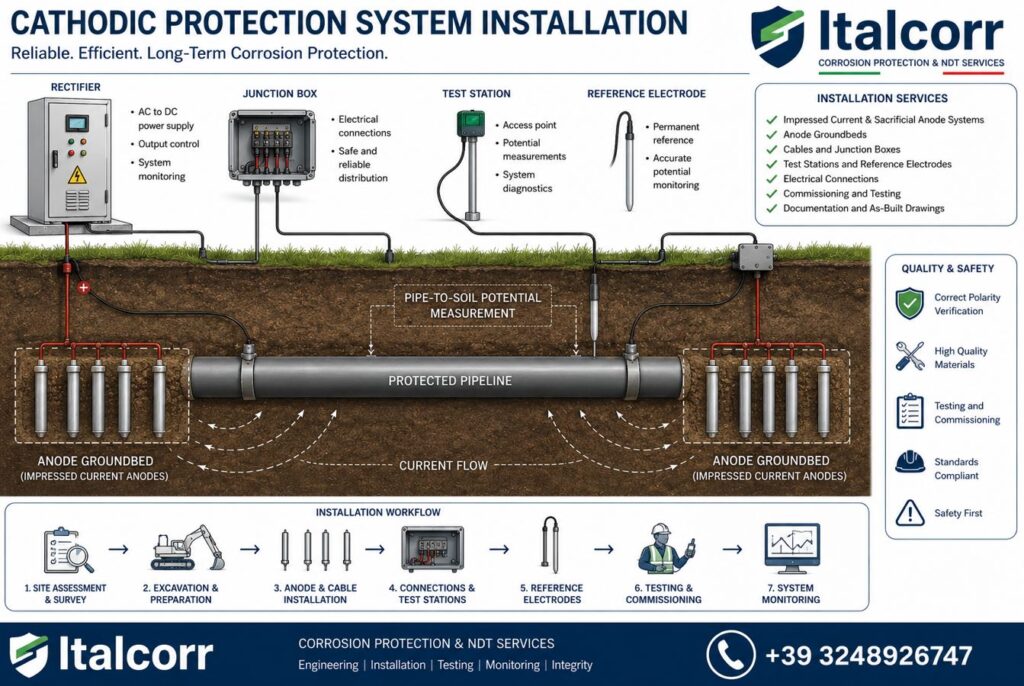
- transformer-rectifier installation;
- installation of impressed current anodes;
- construction of shallow and deep anode groundbeds;
- installation of sacrificial anodes;
- cable installation and connection;
- installation of junction boxes;
- installation of test stations;
- installation of reference electrodes;
- installation of monitoring equipment;
- connection to pipelines, tanks and other protected structures;
- installation and verification of insulating joints;
- electrical testing;
- system commissioning.
Preliminary Site Assessment
Before installation begins, the site conditions and project documentation are reviewed to verify that the proposed system can be installed according to the design.
The preliminary assessment may include:
- verification of the protected structure;
- confirmation of pipeline route and depth;
- identification of existing underground utilities;
- verification of proposed anode locations;
- assessment of site accessibility;
- soil resistivity measurements;
- verification of electrical continuity;
- identification of nearby metallic structures;
- evaluation of possible AC and DC interference;
- verification of available electrical power supply.
Any significant difference between the design assumptions and actual field conditions is evaluated before installation proceeds.
Impressed Current Cathodic Protection Installation
Impressed Current Cathodic Protection systems use an external DC power source to provide the protective current required by the structure.
A typical ICCP installation includes:
Transformer-Rectifier Units
Transformer-rectifiers convert AC electrical power into controlled DC current.
Installation includes:
- positioning and mounting of the rectifier;
- AC power connection;
- DC output connection;
- grounding;
- cable termination;
- polarity verification;
- initial electrical testing.
Correct polarity is essential for cathodic protection operation. The protected structure is connected to the negative terminal, while the anode system is connected to the positive terminal.
Impressed Current Anodes
Depending on the design and operating environment, different types of impressed current anodes may be installed.
The installation process considers:
- anode position;
- installation depth;
- spacing between anodes;
- electrical connections;
- cable protection;
- backfill material;
- soil conditions;
- required current output;
- expected service life.
Proper installation is necessary to ensure uniform current distribution and reliable long-term operation.
Anode Groundbed Installation
The anode groundbed is one of the most important elements of an impressed current cathodic protection system.
Depending on project requirements, Italcorr can install:
- shallow horizontal groundbeds;
- shallow vertical groundbeds;
- distributed anode systems;
- deep anode groundbeds.
Installation activities may include excavation or drilling, positioning of the anodes, installation of conductive backfill, cable routing and connection to the junction box or rectifier.
After installation, the electrical resistance of the groundbed can be measured and compared with the design requirements.
Sacrificial Anode Installation
Sacrificial anode systems provide cathodic protection without an external power supply.
Depending on the application, magnesium, zinc or aluminium alloy anodes may be used.
Installation may include:
- excavation of anode locations;
- preparation of the installation area;
- positioning of packaged or unpackaged anodes;
- cable connection to the protected structure;
- verification of electrical continuity;
- measurement of anode output;
- restoration of the installation area.
Correct spacing and positioning of the anodes are essential to achieve effective current distribution over the protected surface.
Cable Installation and Connections
Cathodic protection cables must provide reliable electrical connections throughout the operating life of the system.
Italcorr performs installation and connection of:
- anode cables;
- cathode cables;
- measurement cables;
- reference electrode cables;
- bonding cables;
- monitoring cables.
Special attention is given to cable insulation, mechanical protection, underground routing, joints and terminations.
Connections to pipelines and other metallic structures are performed using suitable techniques according to project requirements and site conditions.
After installation, connections are tested to verify electrical continuity and correct polarity.
Test Stations
Test stations provide access to electrical connections required for cathodic protection monitoring and diagnostics.
They may include connections to:
- the protected pipeline;
- permanent reference electrodes;
- coupons;
- sacrificial anodes;
- insulating joints;
- neighbouring structures;
- bonding systems.
Test stations are positioned according to the approved design and must remain accessible for future inspection and maintenance activities.
Reference Electrode Installation
Permanent reference electrodes can be installed to provide reliable long-term monitoring of protection potentials.
Depending on the application and environment, different types of reference electrodes may be used.
Correct installation requires careful consideration of:
- electrode position;
- distance from the protected structure;
- soil contact;
- moisture conditions;
- cable routing;
- mechanical protection.
After installation, the electrode response and electrical connection are verified.
Installation of Monitoring Systems
Modern cathodic protection installations can incorporate remote monitoring equipment for continuous or periodic acquisition of operating parameters.
Monitoring systems may record:
- pipe-to-soil potential;
- rectifier output voltage;
- rectifier output current;
- coupon current;
- AC voltage;
- system operating status.
Remote monitoring can improve maintenance efficiency and provide early identification of abnormal operating conditions.
Connections to the Protected Structure
Reliable electrical connection between the cathodic protection system and the protected structure is essential.
Connections may be required on:
- pipelines;
- tanks;
- steel foundations;
- buried metallic structures;
- industrial piping systems.
The connection method is selected according to the structure material, coating, accessibility and applicable technical requirements.
After completion, the connection area is protected against corrosion and coating damage is repaired where necessary.
Insulating Joints
Insulating joints are used to electrically separate protected sections of pipelines or other metallic structures.
During installation and commissioning, Italcorr can verify:
- electrical isolation;
- absence of unintended metallic connections;
- potential difference across the joint;
- integrity of associated cables;
- influence of grounding systems;
- interaction with neighbouring structures.
Correct operation of insulating joints is essential for controlling cathodic protection current distribution.
Quality Control During Installation
Quality control is performed throughout the installation process to verify compliance with the design and project requirements.
Typical checks may include:
- visual inspection of components;
- verification of anode locations;
- cable continuity measurements;
- insulation checks;
- polarity verification;
- connection inspection;
- groundbed resistance measurements;
- reference electrode verification;
- electrical isolation tests;
- verification of test stations.
Installation records provide traceability for future inspection, maintenance and system troubleshooting.
Cathodic Protection System Commissioning
After installation, the cathodic protection system must be commissioned and its performance verified.
Commissioning activities may include:
- verification of electrical connections;
- rectifier startup;
- adjustment of output voltage and current;
- measurement of pipe-to-soil potentials;
- ON potential measurements;
- instant OFF potential measurements;
- verification of reference electrodes;
- measurement of groundbed resistance;
- verification of insulating joints;
- assessment of current distribution;
- interference measurements.
The operating parameters are adjusted according to the characteristics of the protected structure and applicable protection criteria.
Field Testing and Performance Verification
Initial measurements provide a baseline for future monitoring of the cathodic protection system.
Depending on the structure and project requirements, Italcorr may perform:
- pipe-to-soil potential surveys;
- synchronized ON/OFF measurements;
- CIPS Survey;
- DCVG Survey;
- PCM Survey;
- stray current measurements;
- AC interference measurements;
- insulating joint testing.
These techniques can be used to confirm system performance and identify areas requiring further optimization.
Installation Documentation
At the completion of the works, technical documentation may include:
- installation records;
- equipment data;
- anode installation details;
- cable connection records;
- test station information;
- groundbed measurements;
- commissioning results;
- initial potential measurements;
- rectifier operating parameters;
- photographic documentation;
- as-built drawings;
- recommendations for monitoring and maintenance.
Accurate documentation is important for future operation, inspection and modification of the cathodic protection system.
Applications
Italcorr installs cathodic protection systems for:
Pipelines
Gas pipelines, oil pipelines, water pipelines, firewater networks and industrial pipelines.
Aboveground Storage Tanks
Cathodic protection systems for tank bottoms exposed to soil, sand foundations or other conductive environments.
Underground Tanks
Protection of buried storage tanks and associated metallic piping.
Industrial Facilities
Cathodic protection of buried utility networks, process piping and metallic infrastructure.
Metallic Foundations
Cathodic protection systems for steel piles, foundations and other buried or submerged structural components.
From Design to Commissioning
Cathodic protection installation should be considered as part of a complete corrosion control process.
Italcorr can provide an integrated approach including:
Cathodic Protection System Design
Engineering calculations, current requirements, anode selection and system configuration.
Cathodic Protection System Installation
Installation of rectifiers, anodes, groundbeds, cables, test stations and monitoring equipment.
Cathodic Protection Testing and Commissioning
Verification and adjustment of system operating parameters.
Cathodic Protection System Maintenance
Periodic inspection, testing, troubleshooting and optimization.
CIPS, DCVG and PCM Surveys
Detailed assessment of cathodic protection performance and coating condition.
Why Professional Installation Matters
Incorrect installation can significantly reduce the effectiveness and service life of a cathodic protection system.
Typical installation problems may include:
- reversed polarity;
- poor electrical connections;
- damaged cables;
- incorrect anode positioning;
- excessive groundbed resistance;
- defective reference electrodes;
- unintended electrical bonds;
- ineffective insulating joints.
Professional installation and commissioning help ensure that the system operates according to the design and provides reliable long-term corrosion protection.
Italcorr Cathodic Protection Services
Italcorr provides comprehensive cathodic protection services covering the complete lifecycle of corrosion protection systems.
Our activities include engineering, installation, commissioning, inspection, diagnostics, maintenance and performance assessment for pipelines, tanks and other metallic infrastructure.
The integration of cathodic protection engineering, corrosion monitoring and specialized field surveys allows Italcorr to provide solutions focused on long-term asset integrity, reliability and corrosion risk reduction.