
Coercive Force Measurement
Coercive Force Measurement, also known as Magnetic Coercivity Measurement, is a non-destructive diagnostic technique used to assess the metallurgical condition of ferromagnetic materials and monitor changes in their properties throughout their operational service life.
The method can help identify areas potentially affected by structural degradation, plastic deformation, material aging, and changes associated with mechanical and thermal loading.
Magnetic coercivity measurement is applied in the energy, Oil & Gas, railway, metallurgical, and infrastructure asset integrity sectors.
Working Principle
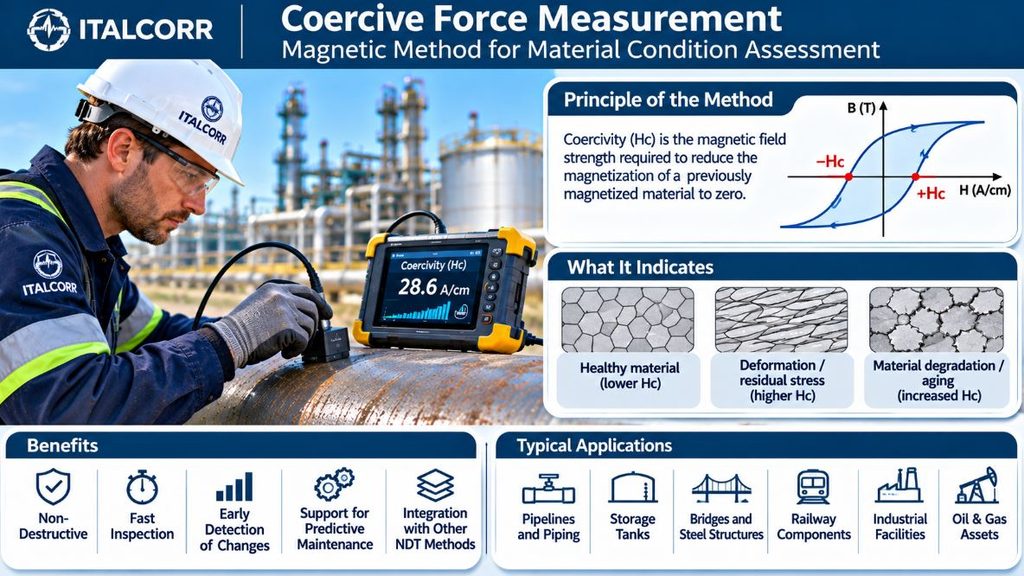
Coercivity is the magnitude of the applied magnetic field required to reduce the magnetization of a previously magnetized material to zero under specified measurement conditions.
Changes in coercivity can be associated with variations in material microstructure, residual stresses, plastic deformation, and mechanical degradation processes.
By performing localized measurements, inspectors can identify variations in magnetic properties and determine areas that may require further investigation or maintenance assessment.
Main Stages of Coercive Force Inspection
Prelimina
Measurement Procedure
Measurements are performed at selected locations using specialized magnetic coercivity measuring instruments.
Data Processing
The recorded values are compared with reference measurements, baseline data, and historical inspection results where available.
Material Condition Assessment
Inspection specialists interpret variations in coercivity to identify areas exhibiting changes in magnetic or metallurgical properties.
Technical Reporting
A technical inspection report is prepared, including measurement results, data tables, inspection maps, technical observations, and recommendations for further assessment.
Information Obtained from Coercivity Measurements
Magnetic coercivity measurements can provide indirect information about:
- Changes in material microstructure
- Residual stress-related variations
- Plastic deformation
- Strain hardening
- Service-induced material degradation
- Effects of heat treatment
- Non-uniform metallurgical conditions
- Areas potentially affected by elevated mechanical loading
Interpretation depends on material composition, heat treatment, magnetic history, measurement conditions, and the availability of appropriate reference data.
Coercivity measurements alone do not provide a direct quantitative determination of mechanical stress, remaining strength, or residual service life.
Advantages of Coercive Force Measurement
- Non-destructive examination
- Rapid localized measurements
- Limited surface preparation in suitable conditions
- Suitable for periodic condition monitoring
- Identification of areas exhibiting changes in material properties
- Support for condition-based maintenance programs
- Integration with complementary NDT techniques
Industrial Applications
Coercive Force Measurement can be applied to:
- Pipelines and piping systems
- Storage tanks and pressure vessels
- Bridges and steel structures
- Railway components
- Power generation equipment
- Industrial facilities
- Welded components
- Structures subjected to cyclic loading
Structural Integrity Monitoring
Magnetic coercivity measurement can support Asset Integrity Management programs by identifying variations in ferromagnetic material properties that may indicate changes in material condition.
The results can help prioritize additional inspections using ultrasonic testing, magnetic particle testing, or other suitable non-destructive testing methods.
Periodic measurements at consistent locations may also provide useful information about changes in material condition over time.
Integration with Other NDT Techniques
For a more comprehensive assessment of asset condition, Coercive Force Measurement can be combined with:
- Ultrasonic Testing (UT)
- Magnetic Particle Testing (MT)
- Visual Testing (VT)
- Vibration Analysis
- Non-Contact Magnetic Inspection (MTM)
- Corrosion Monitoring
Combining magnetic measurements with conventional NDT techniques can improve the interpretation of inspection findings and support informed maintenance decisions.
Applications in the Oil & Gas Industry
In the Oil & Gas sector, magnetic coercivity measurement can be used as a supplementary diagnostic technique for evaluating the condition of ferromagnetic pipelines, storage tanks, supporting structures, and critical components exposed to mechanical and environmental loading.
The method may assist in identifying locations where additional material characterization or structural integrity assessment is required.
Italcorr Coercive Force Measurement Services
Italcorr provides magnetic coercivity measurement services to support metallurgical condition assessment, structural integrity monitoring, and condition-based maintenance programs.
Inspection activities are performed using specialized magnetic measurement equipment and appropriate technical procedures.
The results can be integrated into industrial asset integrity and reliability management programs to support inspection planning, maintenance prioritization, and long-term condition monitoring.