Cathodic Protection System Repair
Cathodic protection systems require reliable operation throughout the entire service life of the protected structure. Failures of rectifiers, anodes, cables, reference electrodes, test stations or electrical connections can reduce the effectiveness of corrosion protection and increase the risk of corrosion damage.
Italcorr provides cathodic protection system repair, troubleshooting and restoration services for pipelines, storage tanks, buried metallic structures and industrial infrastructure.
Repair activities can include fault diagnostics, replacement of defective components, restoration of electrical connections, adjustment of operating parameters and verification of cathodic protection performance after completion of the work.
Cathodic Protection System Troubleshooting
Before repair work begins, the cathodic protection system is inspected to determine the cause and location of the malfunction.
Diagnostic activities may include:
- measurement of rectifier output voltage and current;
- pipe-to-soil potential measurements;
- verification of ON and instant OFF potentials;
- cable continuity testing;
- insulation resistance measurements;
- verification of electrical connections;
- testing of reference electrodes;
- inspection of test stations;
- verification of insulating joints;
- groundbed resistance measurements;
- assessment of current distribution;
- investigation of AC and DC interference.
The results of the inspection are used to determine the required repair activities and identify components that require replacement or adjustment.
Typical Cathodic Protection System Faults
During operation, cathodic protection systems may experience different types of electrical and mechanical failures.
Common problems include:
- insufficient protective current;
- unstable protection potentials;
- transformer-rectifier failure;
- damaged or disconnected cables;
- deterioration of electrical connections;
- increased anode groundbed resistance;
- anode consumption or failure;
- defective reference electrodes;
- damaged test stations;
- loss of electrical continuity;
- failure of insulating joints;
- unintended electrical connections;
- interference from neighbouring structures;
- stray current interference;
- AC interference;
- incorrect system settings.
Correct identification of the root cause is essential before any repair or replacement is performed.
Transformer-Rectifier Repair and Replacement
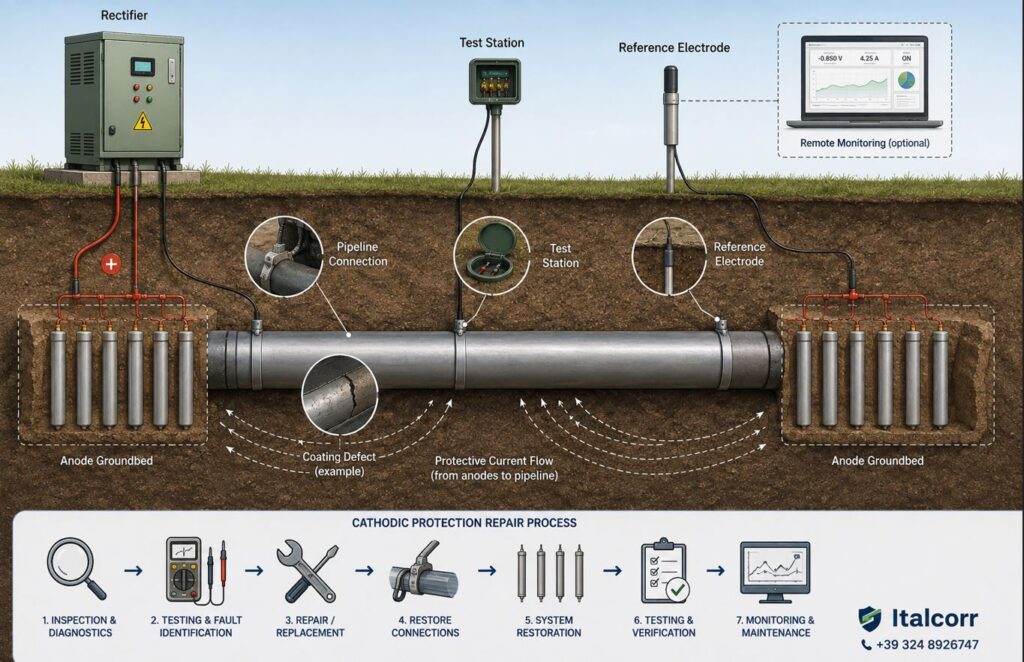
The transformer-rectifier is one of the main components of an Impressed Current Cathodic Protection (ICCP) system.
Typical problems may include:
- absence of DC output;
- unstable output voltage;
- insufficient current;
- damaged electrical components;
- corrosion of terminals;
- defective connections;
- damaged protection devices;
- incorrect operating settings.
Italcorr can inspect the rectifier, verify its electrical parameters and determine whether adjustment, repair or replacement is required.
After the work is completed, output voltage and current are adjusted according to the required cathodic protection conditions.
Anode Groundbed Repair
The performance of an impressed current system depends strongly on the condition of the anode groundbed.
Over time, groundbed performance may deteriorate due to:
- anode consumption;
- cable damage;
- connection failures;
- changes in soil conditions;
- deterioration of conductive backfill;
- increased anode-to-earth resistance.
Diagnostic measurements can be used to evaluate the condition of the groundbed and determine whether individual anodes or the entire groundbed require repair or replacement.
Repair activities may include:
- replacement of damaged anodes;
- installation of additional anodes;
- repair of anode cables;
- restoration of electrical connections;
- replacement or improvement of conductive backfill;
- construction of a new groundbed.
Sacrificial Anode Replacement
Sacrificial anodes are gradually consumed during operation and eventually require replacement.
The condition of the system can be evaluated by measuring:
- structure-to-electrolyte potentials;
- anode current output;
- electrical continuity;
- circuit resistance;
- remaining system performance.
Where necessary, depleted magnesium, zinc or aluminium anodes can be replaced or additional anodes installed to restore the required level of cathodic protection.
Cable Fault Detection and Repair
Damage to cathodic protection cables can cause complete or partial loss of protective current.
Cable failures may occur due to:
- excavation activities;
- mechanical damage;
- ageing of insulation;
- moisture penetration;
- corrosion of connections;
- defective joints;
- construction work near the protected structure.
Italcorr performs cable continuity and electrical tests to identify defective circuits.
Depending on site conditions, repair may involve replacement of damaged cable sections, installation of new cable routes or restoration of electrical connections.
Repair of Electrical Connections
Reliable electrical connections are essential for proper cathodic protection operation.
Connections between the protection system and the structure can deteriorate because of corrosion, mechanical damage or poor previous installation.
Repair activities may include:
- restoration of pipeline connections;
- replacement of damaged terminals;
- repair of cable joints;
- restoration of bonding connections;
- verification of polarity;
- protection of repaired connection areas against corrosion.
After repair, electrical continuity is verified by measurement.
Test Station Repair
Test stations provide access to the electrical circuits required for monitoring and evaluating cathodic protection performance.
Typical defects include:
- damaged terminals;
- broken wires;
- corrosion inside the enclosure;
- missing identification;
- damaged test post structures;
- incorrect or undocumented connections.
Italcorr can restore or replace test stations and verify all associated electrical connections.
Clear identification of terminals and circuits is important for future monitoring and maintenance.
Reference Electrode Replacement
Permanent reference electrodes can deteriorate or become unstable over time.
A defective reference electrode may produce incorrect potential readings and lead to an inaccurate assessment of cathodic protection performance.
Verification may include comparison with a portable calibrated reference electrode.
Where necessary, Italcorr can replace defective permanent reference electrodes and verify their operation after installation.
Insulating Joint Testing and Repair
Insulating joints are used to control electrical continuity between different pipeline sections and neighbouring structures.
Their effectiveness may be compromised by:
- insulation failure;
- conductive contamination;
- grounding connections;
- metallic bypasses;
- damaged surge protection devices;
- unintended electrical bonds.
Italcorr can perform electrical testing to determine whether the insulating joint provides the required isolation.
Where appropriate, associated connections and components can be repaired or replaced.
Restoration of Cathodic Protection Performance
Repairing individual components is only part of the restoration process.
After repair, the complete cathodic protection system should be evaluated to confirm that the protected structure again meets the required protection criteria.
Verification may include:
- rectifier output measurements;
- pipe-to-soil potentials;
- ON potential measurements;
- instant OFF measurements;
- current measurements;
- groundbed resistance;
- reference electrode verification;
- insulating joint testing;
- interference measurements.
System parameters can then be adjusted to achieve effective and stable protection.
Investigation of Insufficient Cathodic Protection
In some cases, all individual components may appear operational while parts of the structure remain insufficiently protected.
Possible causes include:
- deterioration of the pipeline coating;
- increased current demand;
- changes in soil conditions;
- new electrical connections;
- additional buried structures;
- modification of grounding systems;
- deterioration of insulating joints;
- interference from other cathodic protection systems;
- DC stray currents;
- AC interference.
In these situations, a broader diagnostic investigation may be required.
CIPS Survey
A CIPS (Close Interval Potential Survey) provides detailed information about cathodic protection potentials along a buried pipeline.
CIPS can help identify:
- under-protected sections;
- excessive potential variations;
- areas affected by interference;
- changes in current distribution;
- locations requiring additional investigation.
The results can be used to determine whether repair, adjustment or modification of the cathodic protection system is required.
DCVG Survey
A DCVG (Direct Current Voltage Gradient) Survey can be used to locate coating defects that increase the protective current demand.
Significant coating damage can cause localized current losses and reduce the ability of the cathodic protection system to maintain adequate protection over the entire pipeline.
Combining DCVG and CIPS data provides a more complete assessment of both coating condition and cathodic protection performance.
PCM Survey
A PCM (Pipeline Current Mapping) Survey can be used to evaluate current distribution along a pipeline.
Changes in current attenuation may indicate:
- coating deterioration;
- current leakage;
- electrical connections to other structures;
- areas of increased current demand;
- possible system anomalies.
PCM measurements can therefore support troubleshooting and repair planning.
Stray Current and Electrical Interference
Cathodic protection performance may be affected by external electrical sources.
Potential sources include:
- DC railway systems;
- neighbouring cathodic protection systems;
- industrial DC installations;
- high-voltage power lines;
- grounding systems.
Italcorr can perform measurements to identify interference and evaluate its influence on the protected structure.
Where necessary, appropriate mitigation measures can be developed.
Cathodic Protection System Modernization
Older cathodic protection systems may remain operational but no longer provide efficient or reliable protection.
In these cases, repair can be combined with modernization.
Possible improvements include:
- replacement of obsolete rectifiers;
- installation of new anode groundbeds;
- additional test stations;
- installation of permanent reference electrodes;
- improved cable systems;
- installation of monitoring equipment;
- remote monitoring of rectifier parameters;
- optimization of current distribution.
Modernization can extend system service life and improve the reliability of future monitoring.
Emergency Cathodic Protection Repair
Unexpected failures can require rapid intervention, particularly when a major section of pipeline or another critical structure loses cathodic protection.
Italcorr can support troubleshooting and repair activities aimed at:
- locating the fault;
- identifying failed components;
- restoring electrical continuity;
- replacing damaged equipment;
- re-establishing protective current;
- verifying system performance after repair.
The objective is to minimize the period during which the structure operates without adequate corrosion protection.
Repair Documentation
Following repair activities, technical documentation may include:
- description of identified defects;
- diagnostic measurement results;
- list of repaired or replaced components;
- electrical test results;
- rectifier operating parameters;
- pipe-to-soil potential measurements;
- groundbed measurements;
- photographic documentation;
- updated connection diagrams;
- recommendations for future maintenance.
This information provides a useful technical baseline for subsequent inspections.
Applications
Italcorr provides cathodic protection repair services for:
- gas pipelines;
- oil pipelines;
- water pipelines;
- firewater systems;
- industrial pipelines;
- aboveground storage tanks;
- underground tanks;
- buried metallic structures;
- steel foundations;
- industrial facilities and utility networks.
From Diagnostics to Repair and Verification
Effective cathodic protection repair requires more than simply replacing a defective component.
Italcorr combines:
Cathodic Protection Inspection
Identification of electrical and electrochemical anomalies.
Cathodic Protection System Repair
Repair or replacement of defective components and electrical connections.
CIPS, DCVG and PCM Surveys
Detailed investigation of protection performance, coating condition and current distribution.
Cathodic Protection Testing and Commissioning
Verification and adjustment of the repaired system.
Cathodic Protection System Maintenance
Periodic inspection and preventive maintenance to reduce the risk of future failures.
Why Cathodic Protection Repair Is Important
A partially functioning cathodic protection system may create the impression that a structure is protected even when some areas do not meet the required protection criteria.
Periodic diagnostics and timely repair help to:
- restore effective corrosion protection;
- prevent prolonged under-protection;
- identify hidden electrical faults;
- reduce the risk of corrosion-related failures;
- improve system reliability;
- extend the service life of existing equipment;
- optimize maintenance costs;
- support long-term asset integrity.
Italcorr Cathodic Protection Services
Italcorr provides comprehensive services for the inspection, troubleshooting, repair and optimization of cathodic protection systems.
By combining cathodic protection engineering, electrical diagnostics, corrosion monitoring and specialized pipeline surveys, Italcorr can identify the causes of system malfunction and develop appropriate solutions to restore reliable corrosion protection.
Our services cover the complete cathodic protection lifecycle, from system design and installation to commissioning, maintenance, repair and performance assessment.