Eddy Current Testing (ET)
Eddy Current Testing (ET) is an advanced non-destructive testing (NDT) technique used to detect surface and near-surface defects, corrosion, wall thickness loss, and material anomalies in electrically conductive materials.
Due to its high sensitivity, inspection speed, and versatility, Eddy Current Testing is widely applied in the energy, Oil & Gas, aerospace, railway, manufacturing, and industrial maintenance sectors.
Working Principle
Eddy Current Testing is based on electromagnetic induction. An alternating current flowing through an inspection coil generates a changing magnetic field, which induces circulating electrical currents, known as eddy currents, within the conductive material.
These induced currents generate secondary magnetic fields that interact with the inspection coil.
The presence of cracks, corrosion, thickness variations, or changes in material properties affects the distribution of eddy currents and produces measurable changes in the probe signal.
By analyzing these signals, qualified inspectors can detect and characterize discontinuities and material anomalies.
Main Stages of Eddy Current Inspection
Preliminary Assessment
Inspection objectives, material properties, component geometry, and the most appropriate testing techniques are evaluated.
Equipment Calibration
The inspection equipment is calibrated using suitable reference standards containing known artificial discontinuities or representative defects.
Calibration procedures are performed in accordance with applicable technical standards and inspection requirements.
Inspection Procedure
Eddy current probes are positioned or scanned along the inspection surface to acquire electromagnetic response data in real time.
Signal Analysis
Changes in signal amplitude, phase, and impedance are interpreted to identify potential defects, corrosion, or variations in material properties.
Technical Reporting
A detailed technical inspection report is prepared, documenting the inspection procedure, results, findings, and relevant assessments.
Detectable Defects and Anomalies
Eddy Current Testing can help detect:
- Surface-breaking cracks
- Fatigue cracks
- Corrosion damage
- Wall thickness loss
- Material wear
- Manufacturing defects
- Certain stress-related material anomalies
- Defects in heat exchanger tubes
- Changes in the properties of conductive materials
Detection capabilities depend on the material, probe configuration, inspection frequency, defect orientation, and selected testing technique.
Inspectable Materials
Eddy Current Testing can be applied to electrically conductive materials, including:
- Carbon steels
- Stainless steels
- Aluminium and aluminium alloys
- Copper and copper alloys
- Titanium
- Nickel and special alloys
Conventional eddy current techniques are particularly effective for non-ferromagnetic materials.
Ferromagnetic materials may require specialized inspection methods, appropriate signal processing, or alternative electromagnetic techniques.
Heat Exchanger and Tube Inspection
One of the main industrial applications of electromagnetic testing is the inspection of:
- Tube bundles
- Condensers
- Heat exchangers
- Steam generators
- Industrial cooling systems
Eddy current techniques can identify corrosion, erosion, cracking, and wall thickness loss in suitable tubing materials.
Internal probe inspection can often be performed without removing individual tubes from the equipment, although access preparation and equipment shutdown may be required.
For ferromagnetic tubing, specialized techniques such as Remote Field Testing (RFT) may be more appropriate.
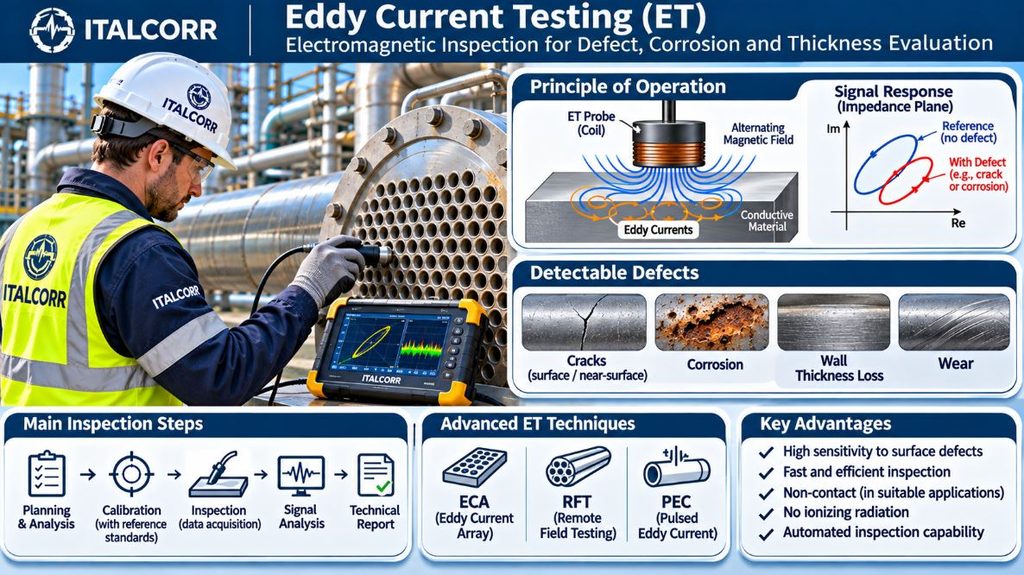
Advanced Eddy Current Testing Techniques
Eddy Current Array (ECA)
Eddy Current Array technology uses multiple sensing elements arranged in a probe to provide wider inspection coverage and improved scanning efficiency compared with conventional single-element probes.
ECA can support detailed surface inspection and defect mapping in suitable conductive materials.
Remote Field Testing (RFT)
Remote Field Testing is an electromagnetic inspection technique primarily used for ferromagnetic tubes.
It is particularly suitable for detecting and assessing internal and external wall loss in heat exchanger tubes, boilers, and similar tubular components.
Pulsed Eddy Current (PEC)
Pulsed Eddy Current Testing is an advanced electromagnetic technique that uses transient magnetic fields to assess material condition and estimate average remaining wall thickness in suitable ferromagnetic components.
PEC can be used to screen for corrosion and wall thickness loss through certain protective coatings, insulation systems, and non-conductive coverings.
This makes the method useful for corrosion under insulation (CUI) screening in industrial facilities.
PEC results generally represent an averaged response over the inspection area and may require complementary NDT methods for detailed defect characterization.
Advantages of Eddy Current Testing
- High sensitivity to surface and near-surface discontinuities
- Rapid and efficient inspection procedures
- Non-contact inspection capability in suitable applications
- No ionizing radiation
- High inspection productivity
- Potential for automated inspection systems
- Minimal surface preparation in many applications
- Suitable for condition monitoring and quality control
Limitations
Eddy Current Testing is applicable only to electrically conductive materials.
Inspection performance depends on material conductivity, magnetic permeability, component geometry, surface condition, probe lift-off, and inspection frequency.
Conventional eddy current methods have limited penetration depth, and the interpretation of electromagnetic signals requires qualified personnel.
Specialized techniques or complementary NDT methods may be necessary for ferromagnetic materials, complex geometries, or deeper defects.
Industrial Applications
Italcorr provides Eddy Current Testing and electromagnetic inspection services for:
- Heat exchangers
- Condensers
- Industrial piping systems
- Oil & Gas facilities
- Power generation plants
- Aerospace components
- Metallic structures
- Critical industrial equipment
Italcorr Eddy Current Testing Services
Italcorr provides Eddy Current Testing services to support defect detection, corrosion assessment, equipment condition monitoring, and industrial asset integrity management.
Our inspection activities are aimed at identifying material discontinuities, evaluating potential degradation mechanisms, and supporting maintenance and operational decisions.
Eddy current inspection results can be integrated with other NDT techniques, including Ultrasonic Testing (UT), Visual Testing (VT), and Magnetic Particle Testing (MT), to provide a more comprehensive assessment of industrial asset condition.