
VISUAL TESTING (VT)
Visual Testing (VT) is one of the simplest, fastest, and most cost-effective non-destructive testing (NDT) methods for the preliminary assessment of industrial components, structures, and facilities. In many cases, it represents the first stage of an inspection program, allowing visible anomalies to be identified before more advanced inspection techniques are applied.
Visual testing is widely used in the Oil & Gas, energy, chemical, infrastructure, steel construction, and industrial engineering sectors.
Working Principle
Visual Testing involves the direct or remote examination of surfaces by qualified personnel using appropriate optical instruments. The objective is to identify defects, anomalies, corrosion, deformation, and conditions that may compromise asset integrity.
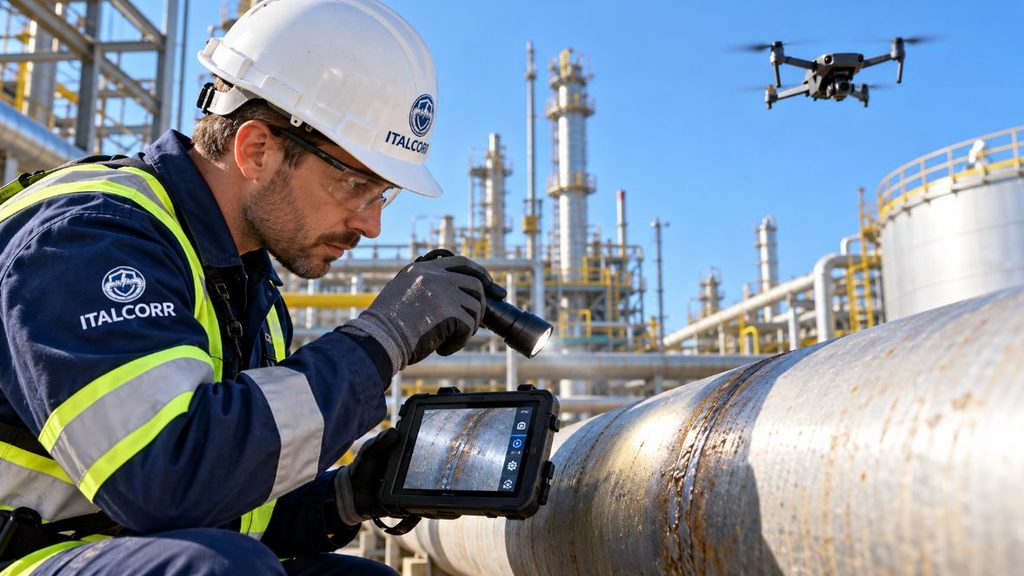
Inspections can be performed with the naked eye or using magnifying devices, cameras, industrial endoscopes, drones, and digital imaging systems.
Main Stages of Visual Testing
Inspection Preparation
The component, operating conditions, inspection requirements, and applicable technical standards are reviewed.
Direct Visual Testing
The inspector examines accessible surfaces to identify visible defects and anomalies.
Remote Visual Testing
Borescopes, industrial endoscopes, cameras, and drones can be used to inspect difficult-to-access areas.
Documentation of Findings
Inspection findings are recorded through photographs, inspection checklists, and technical reports.
Technical Assessment
Inspection results are evaluated to determine whether additional NDT examinations, maintenance activities, or corrective actions are required.
Detectable Defects and Anomalies
Visual Testing can identify:
- Surface corrosion
- Localized corrosion
- Deformation
- Dents
- Leaks and seepage
- Visible welding defects
- Mechanical damage
- Erosion
- Protective coating deterioration
- Manufacturing and dimensional anomalies
Inspection Equipment
Italcorr uses various technologies to support visual inspection activities:
- Dimensional measurement instruments
- Industrial borescopes and endoscopes
- High-resolution cameras
- Unmanned Aerial Vehicles (UAVs)
- Professional photographic equipment
- Inspection documentation and reporting software
Advantages of Visual Testing
- Fast inspection procedures
- Cost-effective implementation
- Applicability to a wide range of industrial components
- Immediate identification of visible anomalies
- Support for planning additional NDT examinations
- Photographic documentation of asset condition
Limitations
Visual Testing is limited to defects and anomalies that are visible or optically accessible. It cannot directly detect internal discontinuities within a material.
Additional NDT methods, such as Ultrasonic Testing (UT), Radiographic Testing (RT), or Magnetic Particle Testing (MT), may be required for a more comprehensive integrity assessment.
Industrial Applications
Italcorr performs visual inspections on:
- Pipelines and piping systems
- Storage tanks and pressure vessels
- Steel structures
- Bridges and viaducts
- Power transmission and distribution lines
- Industrial facilities
- Service stations and fuel storage facilities
- Energy installations
- Civil and industrial infrastructure
Drone-Based Visual Inspection
For large-scale infrastructure and difficult-to-access areas, Italcorr uses UAV-based inspection technologies to conduct efficient visual surveys while reducing the need for direct physical access, minimizing operational disruption, and improving inspection safety.
Drone inspections can support the assessment of elevated structures, industrial facilities, pipelines, bridges, and power infrastructure.
Italcorr Visual Inspection Services
Italcorr provides visual testing and technical inspection services in accordance with applicable international standards and project-specific requirements.
Our inspection activities support asset integrity assessment, early identification of deterioration mechanisms, maintenance planning, and risk-based asset management.
Visual inspection results can also be integrated with other NDT techniques to provide a more comprehensive evaluation of industrial asset condition.