MTM – Magnetic Tomography Method, Non-Contact Magnetic Inspection
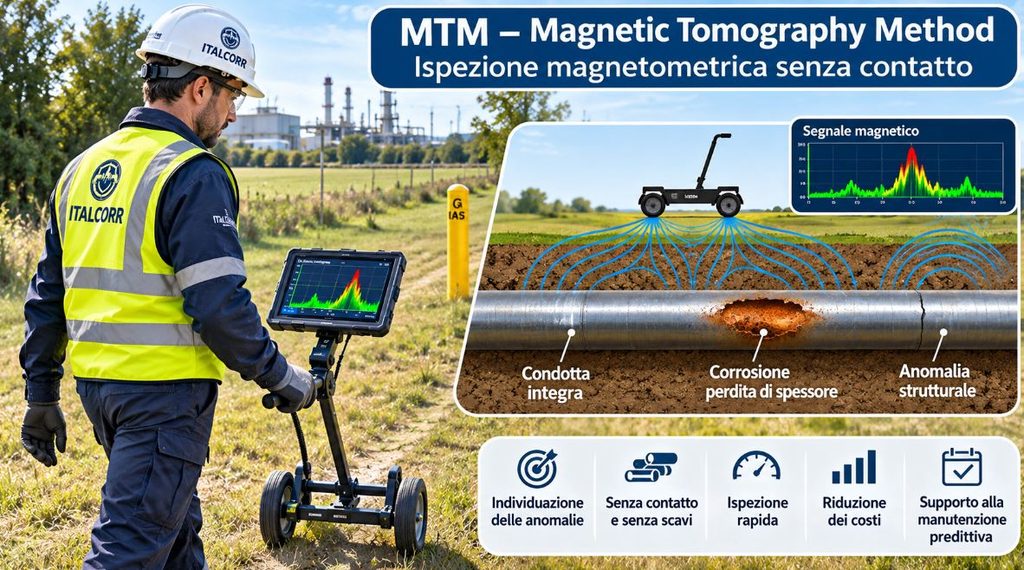
Magnetic Tomography Method (MTM), also referred to as Non-Contact Magnetic Inspection, is a non-destructive inspection technique used for preliminary integrity assessment of pipelines, metallic structures, and buried infrastructure without direct physical contact with the inspected asset or excavation.
The method involves detecting and analyzing magnetic field anomalies that may be associated with corrosion, metal loss, structural discontinuities, mechanical stress concentrations, and changes in material properties.
MTM can provide valuable screening information for asset integrity management, helping operators identify potentially critical areas and prioritize further inspections.
This technology is particularly applicable to gas transmission pipelines, oil pipelines, water networks, energy infrastructure, and extensive ferromagnetic structures.
Working Principle of Magnetic Tomography Method (MTM), Non-Contact Magnetic Inspection
Ferromagnetic structures exhibit magnetic fields influenced by their magnetic properties, operating conditions, mechanical history, and the surrounding environment.
Changes in material condition, corrosion-related metal loss, geometric discontinuities, and mechanical loading may produce local variations in the measured magnetic field.
Using high-sensitivity magnetometric sensors, these variations can be recorded and analyzed to identify locations requiring further investigation.
Measurements are performed without direct contact with the structure, enabling non-invasive inspections along accessible survey routes.
Main Stages of MTM Inspection
Data Acquisition
Magnetic field measurements are collected along the pipeline route or infrastructure using specialized magnetometric equipment.
Signal Processing
The acquired data are processed using dedicated software to identify magnetic field variations and anomalous signal patterns.
Anomaly Analysis
Inspection specialists interpret the recorded signals, considering potential relationships with corrosion, structural discontinuities, mechanical loading, and environmental magnetic interference.
Classification of Critical Areas
Detected anomalies are classified according to their characteristics, relative significance, and priority for further verification.
Technical Reporting
A technical inspection report is prepared, including survey results, magnetic anomaly profiles, location information, graphical representations, and recommendations for additional investigations.
Information Obtained from MTM Inspection
Non-contact magnetic inspection can help identify areas potentially associated with:
- Corrosion-related metal loss
- Structural discontinuities
- Changes in magnetic material properties
- Mechanical stress concentrations
- Pipeline deformation or ground movement
- Localized deterioration
- Possible weld-related anomalies
- Sections requiring detailed integrity assessment
- Priority locations for verification excavations
Magnetic anomalies are indirect indicators and do not independently establish the presence, type, or dimensions of a defect.
Advantages of Magnetic Tomography Method
- No direct physical contact with the pipeline
- No excavation required for initial screening
- Rapid inspection of accessible pipeline routes
- Potential reduction in unnecessary verification excavations
- Suitable for surveying extended pipeline sections
- Preliminary identification of potentially critical locations
- Support for risk-based inspection and maintenance planning
Applications to Buried Pipelines
MTM can be applied to the preliminary screening of:
- Natural gas pipelines
- Oil pipelines
- Water transmission pipelines
- Firewater networks
- Industrial piping systems
- Energy infrastructure
Inspection results help identify locations where additional investigations, direct examinations, or complementary NDT techniques may be appropriate.
Corrosion Monitoring
Non-contact magnetic inspection can complement corrosion monitoring and pipeline integrity management programs by identifying magnetic anomalies that may be associated with material deterioration.
The method supports the prioritization of further examinations but does not replace direct wall thickness measurements or established corrosion assessment techniques.
Integration with Other Inspection Techniques
For a more comprehensive assessment of pipeline condition, MTM can be integrated with:
- Close Interval Potential Survey (CIPS)
- Direct Current Voltage Gradient Survey (DCVG)
- Pearson Survey
- Pipeline Current Mapping (PCM)
- Pipe-to-Soil Potential Measurements
- Ultrasonic Testing (UT)
- Visual Testing (VT)
- Corrosion Engineering and Assessment
Combining magnetic inspection with electrochemical surveys and conventional NDT methods can improve the interpretation of inspection findings and support more informed maintenance decisions.
Industrial Applications
Italcorr provides non-contact magnetic inspection services for:
- Oil & Gas pipeline networks
- Water transmission and distribution systems
- Industrial facilities
- Energy infrastructure
- Ferromagnetic structures
- Pipeline transportation and distribution networks
Italcorr Magnetic Inspection Services
Italcorr provides non-contact magnetic inspection services to support infrastructure integrity assessment, identification of potentially critical areas, and maintenance planning.
Our inspection activities aim to support operational risk management, optimize inspection resources, and improve the reliability of industrial assets.
MTM results can be used as part of a broader integrity assessment program, with follow-up verification performed where necessary.
Benefits for Clients
Non-contact magnetic inspection can help operators reduce unnecessary excavations, focus detailed inspections on prioritized locations, improve maintenance planning, and support safer infrastructure operation.
By combining MTM screening with complementary inspection techniques, asset owners can make more informed decisions about inspection priorities and maintenance activities.