
Cathodic Protection of Tanks
Cathodic protection is an effective method for controlling corrosion of metallic storage tanks exposed to soil, water and other conductive environments. It is particularly important for aboveground storage tank bottoms, underground tanks, water tanks and industrial storage facilities, where corrosion can lead to leakage, environmental contamination, product loss and costly repairs.
Italcorr provides cathodic protection engineering, inspection, monitoring and maintenance services for storage tanks, helping operators reduce corrosion risks and extend the service life of critical assets.
Why Cathodic Protection Is Required
Steel tank surfaces exposed to soil, sand foundations, groundwater or stored water can develop electrochemical corrosion cells.
For aboveground storage tanks, corrosion of the bottom plates is particularly important because the external surface of the tank bottom may be difficult or impossible to inspect during normal operation.
The corrosion rate can be influenced by:
- soil and foundation resistivity;
- moisture content;
- chemical composition of the environment;
- condition of protective coatings;
- temperature;
- electrical contact with other structures;
- stray DC currents;
- AC interference;
- condition and design of the tank foundation.
Cathodic protection provides an additional level of corrosion control by reducing electrochemical corrosion activity on the protected steel surface.
Aboveground Storage Tanks
Cathodic protection can be applied to the external bottom surface of Aboveground Storage Tanks (AST).
Depending on the tank design and foundation, the protection system may use impressed current or galvanic anodes installed beneath or around the tank.
Typical applications include:
- crude oil storage tanks;
- petroleum product tanks;
- chemical storage tanks;
- fuel storage facilities;
- refinery tanks;
- industrial storage tanks;
- water storage tanks.
For new tanks, the cathodic protection system can be incorporated into the foundation during construction.
Existing tanks can also be evaluated for the installation or modernization of cathodic protection systems.
Underground Storage Tanks
Underground steel tanks are directly exposed to the surrounding soil and therefore require effective corrosion control.
Cathodic protection can be provided using either galvanic anodes or impressed current cathodic protection systems (ICCP).
Typical applications include:
- fuel storage tanks;
- underground petroleum tanks;
- industrial process tanks;
- water tanks;
- buried vessels and metallic containers.
The protection system should be designed considering tank dimensions, coating condition, soil resistivity, electrical isolation and required operating life.
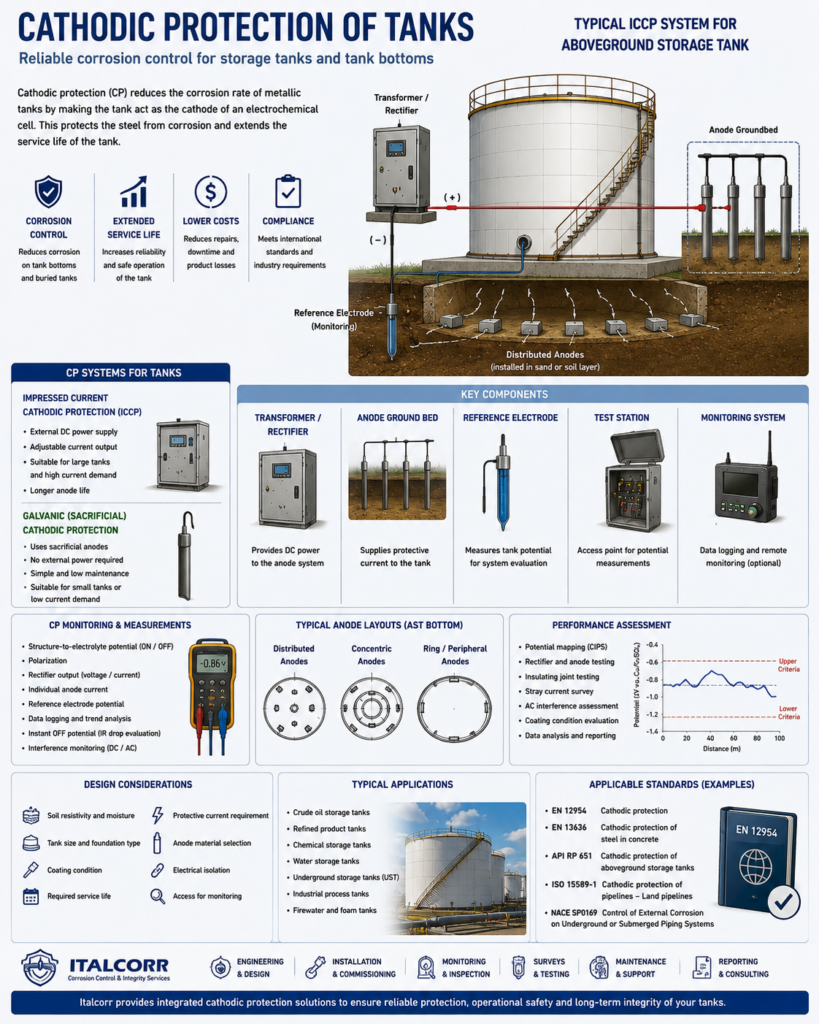
Impressed Current Cathodic Protection
An Impressed Current Cathodic Protection (ICCP) system uses an external DC power source to supply protective current to the tank.
A typical system may include:
- transformer-rectifier unit;
- impressed current anodes;
- reference electrodes;
- monitoring points;
- junction boxes;
- electrical cables;
- test stations;
- remote monitoring equipment.
ICCP systems provide adjustable current output and are particularly suitable for large tanks or installations with relatively high current demand.
Galvanic Anode Cathodic Protection
Galvanic cathodic protection uses sacrificial anodes electrically connected to the tank.
Depending on the environment, anodes may be manufactured from materials such as magnesium, zinc or aluminium alloys.
The anodes gradually consume while providing protective current to the tank.
Galvanic systems are simple and do not require an external DC power supply, making them suitable for certain tank configurations and operating conditions.
Tank Bottom Cathodic Protection
The external surface of an aboveground tank bottom is one of the most critical areas from a corrosion perspective.
Cathodic protection systems can be designed using different anode arrangements, including:
- distributed anodes beneath the tank bottom;
- concentric anode systems;
- linear anodes;
- peripheral anodes;
- remote anode systems.
The optimum configuration depends on tank diameter, foundation construction, soil or sand resistivity, coating condition and required current distribution.
Proper anode positioning is essential to achieve uniform protection across the entire tank bottom.
Reference Electrodes and Monitoring
Reference electrodes allow the potential of the protected structure to be measured and the effectiveness of cathodic protection to be evaluated.
Permanent reference electrodes may be installed beneath tank bottoms during construction.
Monitoring may include:
- structure-to-electrolyte potential measurements;
- ON potential measurements;
- Instant OFF potential measurements;
- polarization measurements;
- rectifier voltage and current;
- individual anode current;
- reference electrode measurements;
- potential distribution across the tank bottom.
Regular monitoring helps identify changes in system performance before significant corrosion damage develops.
Stray Current Interference
Storage tanks located near railways, pipelines, cathodic protection systems or industrial electrical installations may be affected by stray currents.
Interference can cause localized corrosion where current leaves the tank structure.
Italcorr can perform measurements to identify interference sources, evaluate their effect on the tank and determine appropriate mitigation measures.
Cathodic Protection Performance Assessment
Existing tank cathodic protection systems should be periodically assessed to verify their effectiveness.
The assessment may include:
- potential measurements;
- rectifier inspection and testing;
- anode current measurements;
- verification of reference electrodes;
- electrical continuity testing;
- inspection of cables and connections;
- evaluation of electrical isolation;
- stray current measurements;
- analysis of historical monitoring data.
The results allow the actual performance of the system to be determined and areas requiring maintenance or optimization to be identified.
Design of Cathodic Protection Systems
The design of a tank cathodic protection system requires evaluation of the structure, environment and required operating life.
The engineering process may include:
- collection of tank and foundation data;
- soil or sand resistivity measurements;
- determination of the surface area to be protected;
- estimation of protective current demand;
- selection of the cathodic protection system;
- calculation of anode quantity and operating life;
- design of anode distribution;
- selection of reference electrodes;
- cable and electrical connection design;
- preparation of drawings and technical documentation.
The objective is to provide adequate and uniform protection throughout the required service life.
Applicable Standards
Cathodic protection systems for storage tanks are designed and evaluated according to the applicable international and European standards, project specifications and regulatory requirements.
Depending on the application, relevant standards and technical references may include EN 13636, EN 12954, API RP 651 and other applicable requirements.
Italcorr Cathodic Protection Services for Tanks
Italcorr provides comprehensive cathodic protection services for aboveground and underground storage tanks, including:
- cathodic protection system design;
- soil resistivity measurements;
- current requirement calculations;
- anode system design;
- installation supervision;
- testing and commissioning;
- tank potential monitoring;
- cathodic protection performance assessment;
- inspection of rectifiers and anode systems;
- reference electrode testing;
- stray current investigation;
- troubleshooting;
- maintenance and system optimization;
- technical reports and recommendations.
A properly designed and maintained cathodic protection system can significantly reduce external corrosion, extend tank service life, improve operational reliability and reduce the risk of leakage and environmental damage.