
Cathodic Protection Performance Assessment
Cathodic Protection Performance Assessment is a comprehensive technical evaluation used to determine whether a cathodic protection system provides adequate and reliable corrosion protection for buried or submerged metallic structures.
The assessment goes beyond individual potential measurements. It evaluates the complete cathodic protection system, including protection potentials, current distribution, transformer-rectifier performance, anode systems, electrical continuity, insulating joints, coating condition and possible interference from external electrical sources.
Italcorr provides cathodic protection performance assessment services for pipelines, storage tanks, industrial facilities and other buried or submerged metallic structures.
Purpose of Cathodic Protection Performance Assessment
The main objective is to determine whether the cathodic protection system is operating effectively and whether the protected structure meets the applicable protection criteria.
The assessment can help to:
- verify the effectiveness of cathodic protection;
- identify under-protected sections;
- identify possible overprotection;
- detect abnormal potential distribution;
- evaluate CP current distribution;
- identify equipment failures;
- assess the condition of anode systems;
- identify coating-related problems;
- detect electrical interference;
- evaluate the condition of insulating joints;
- determine whether system adjustment or repair is required;
- support maintenance and integrity management decisions.
Initial Technical Review
Before field measurements, available technical documentation is reviewed.
This may include:
- cathodic protection design documentation;
- pipeline or structure drawings;
- previous CP inspection reports;
- historical potential measurements;
- transformer-rectifier records;
- anode system information;
- coating specifications;
- insulating joint locations;
- previous CIPS, DCVG or PCM surveys;
- repair and maintenance history;
- information about nearby electrical installations.
Historical information is particularly useful for identifying changes in system performance over time.
Structure-to-Electrolyte Potential Measurements
Potential measurements are one of the principal components of the assessment.
Depending on the structure and CP system, measurements may include:
- pipe-to-soil potentials;
- structure-to-electrolyte potentials;
- ON potentials;
- instant OFF potentials;
- native potentials;
- polarization measurements;
- potentials at critical locations.
Measurements are performed using suitable reference electrodes and high-input-impedance instruments.
The results are evaluated according to applicable standards, project specifications and the characteristics of the protected structure.
ON and Instant OFF Potential Assessment
ON potentials provide information about the electrical condition of the structure while the cathodic protection system is operating.
However, ON measurements may contain IR-drop components caused by current flowing through the electrolyte.
Where required, instant OFF potentials can be measured by interrupting the cathodic protection current.
This allows the effect of IR drop to be reduced and provides additional information about the actual polarization condition of the structure.
For systems influenced by several CP stations, synchronized interruption may be required.
Transformer-Rectifier Assessment
For impressed current cathodic protection systems, transformer-rectifier units are inspected and their operating parameters recorded.
Typical checks include:
- DC output voltage;
- DC output current;
- input voltage;
- operating stability;
- output adjustment;
- electrical connections;
- cable condition;
- protective devices;
- cabinet condition;
- grounding;
- signs of overheating or deterioration.
Measured rectifier output is compared with historical values and the requirements of the protected structure.
Significant changes in output may indicate changes in coating condition, groundbed resistance or electrical continuity.
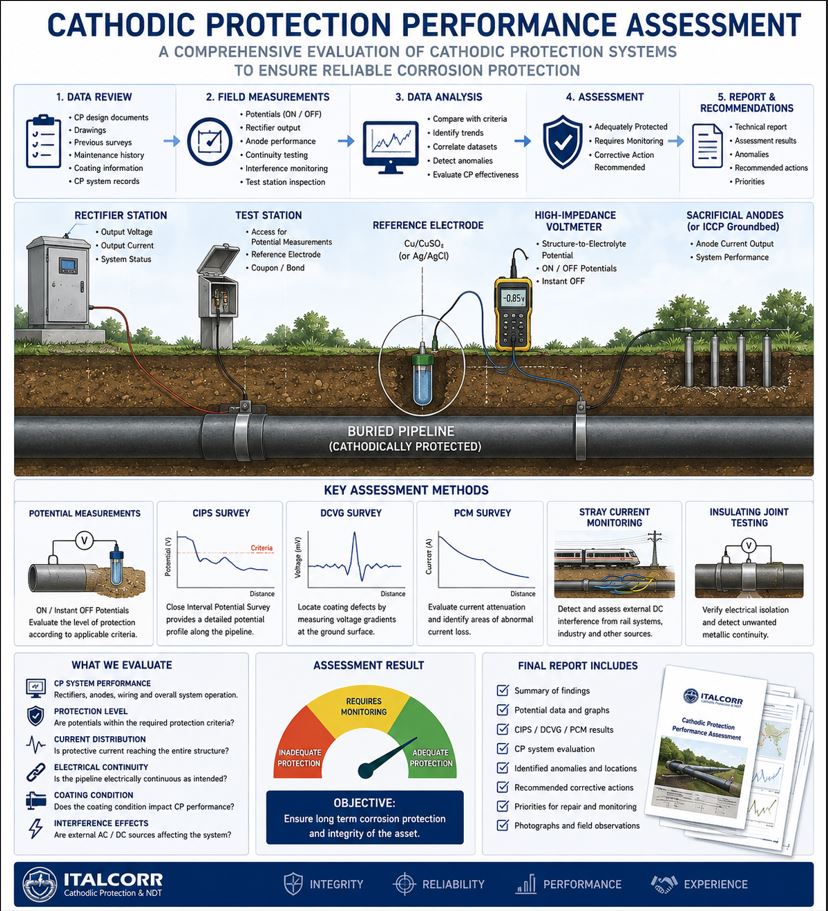
Groundbed and Anode Assessment
The condition and performance of the anode system are important elements of CP performance.
For impressed current systems, assessment may include:
- groundbed current output;
- circuit resistance;
- cable continuity;
- anode distribution;
- changes in groundbed resistance;
- evidence of anode deterioration.
For galvanic systems, measurements may include:
- structure potential;
- anode potential;
- anode current output;
- circuit resistance;
- electrical continuity.
These measurements can help identify anode depletion or connection problems.
Electrical Continuity
Cathodic protection requires appropriate electrical continuity of the protected structure.
Continuity testing may be performed between:
- pipeline sections;
- connected structures;
- tanks and piping;
- bonds;
- test stations;
- structural components.
Unexpected resistance or potential differences may indicate defective connections or unintended electrical isolation.
Insulating Joint Testing
Insulating joints are used to control the distribution of cathodic protection current between different pipeline sections or structures.
Their condition can significantly affect CP system performance.
Assessment may include measurements on both sides of the joint to identify:
- loss of electrical isolation;
- metallic bypasses;
- grounding connections;
- abnormal potential differences;
- current leakage;
- interference between adjacent pipeline sections.
A failed insulating joint can significantly change CP current distribution.
Coating Condition and Current Demand
Cathodic protection performance is closely related to coating condition.
As pipeline coating deteriorates, the exposed metallic surface increases and the cathodic protection system must supply more current.
Possible indications of coating deterioration include:
- increasing rectifier current;
- abnormal current attenuation;
- localized potential changes;
- difficulty maintaining adequate protection;
- changes compared with historical measurements.
Additional coating surveys may therefore be recommended when abnormal CP performance is detected.
Stray Current Interference
External DC systems can significantly influence cathodic protection measurements and corrosion risk.
Potential interference sources may include:
- electrified railways;
- tram systems;
- metro systems;
- neighbouring cathodic protection systems;
- industrial DC installations.
Continuous potential and current monitoring can be performed where dynamic stray current interference is suspected.
AC Interference
Pipelines located near high-voltage overhead lines or AC railway systems may be exposed to induced AC voltage.
Where relevant, the performance assessment may also include:
- AC pipe-to-soil voltage;
- AC current measurements;
- grounding system assessment;
- mitigation system verification;
- evaluation of AC interference locations.
AC and DC conditions should be considered together when assessing overall corrosion protection.
Test Station Inspection
Permanent cathodic protection test stations provide important access points for system evaluation.
Inspection may include:
- terminal condition;
- cable identification;
- electrical connections;
- reference electrodes;
- bonds;
- coupons;
- insulating joint connections;
- enclosure condition;
- measurement functionality.
Damaged or incorrectly connected test stations can produce unreliable measurements and complicate system maintenance.
Data Analysis
Field measurements are processed and compared with:
- applicable cathodic protection criteria;
- previous survey results;
- design parameters;
- historical rectifier outputs;
- previous potential measurements;
- coating survey results;
- known interference conditions.
This allows both localized anomalies and long-term trends to be identified.
Performance Classification
Following analysis, pipeline or structure sections can be classified according to their cathodic protection condition.
For example:
Adequately Protected
Measured conditions indicate satisfactory cathodic protection.
Requires Monitoring
Some parameters show deviations or instability but do not necessarily require immediate intervention.
Corrective Action Recommended
Measurements indicate insufficient or abnormal cathodic protection requiring adjustment, repair or additional investigation.
The final classification should always be based on the applicable technical criteria and complete measurement dataset.
Corrective Actions
Depending on the assessment results, recommendations may include:
- adjustment of transformer-rectifier output;
- repair or replacement of rectifiers;
- installation of additional anodes;
- groundbed rehabilitation;
- repair of damaged cables;
- restoration of electrical continuity;
- repair of insulating joints;
- coating repair;
- installation or adjustment of drainage systems;
- stray current mitigation;
- AC interference mitigation;
- installation of additional monitoring points;
- additional CIPS, DCVG or PCM surveys.
Periodic Performance Assessment
Cathodic protection performance can change over time because of:
- coating ageing;
- anode consumption;
- soil condition changes;
- equipment deterioration;
- new pipeline connections;
- changes in surrounding infrastructure;
- electrical interference;
- modification of neighbouring CP systems.
Periodic assessments therefore provide important information about long-term corrosion protection performance.
Applications
Cathodic Protection Performance Assessment can be performed for:
- oil pipelines;
- gas pipelines;
- water pipelines;
- firewater systems;
- industrial pipelines;
- aboveground storage tanks;
- underground storage tanks;
- buried metallic structures;
- steel foundations;
- industrial facilities;
- marine and submerged structures.
Integrated Cathodic Protection Assessment
A major advantage of a comprehensive assessment is the ability to combine several diagnostic methods.
Italcorr can integrate:
Potential Monitoring — evaluation of protection potentials and their stability.
CIPS Survey — detailed potential profile along pipelines.
DCVG Survey — coating defect localization and assessment.
PCM Survey — evaluation of current distribution and attenuation.
Pearson Survey — detection of coating discontinuities.
Stray Current Assessment — investigation of external DC interference.
AC Interference Assessment — evaluation of induced AC effects.
Insulating Joint Testing — verification of electrical isolation.
Correlation of these measurements provides a more reliable assessment than evaluation based on a single inspection method.
Cathodic Protection Performance Assessment Report
The final technical report may include:
- description of the protected structure;
- CP system configuration;
- inspection methodology;
- measurement locations;
- potential measurements;
- transformer-rectifier parameters;
- anode system assessment;
- electrical continuity results;
- insulating joint assessment;
- interference measurements;
- CIPS/DCVG/PCM results where applicable;
- comparison with historical data;
- identified anomalies;
- assessment of cathodic protection effectiveness;
- recommended corrective actions;
- priorities for repair and additional investigation.
Cathodic Protection Performance Assessment by Italcorr
Italcorr provides comprehensive cathodic protection performance assessment for pipelines, storage tanks and other buried or submerged metallic structures.
The assessment combines field measurements, inspection of cathodic protection equipment, analysis of historical data and, where necessary, advanced diagnostic methods such as CIPS, DCVG, PCM and Pearson Survey.
The objective is not only to determine whether the cathodic protection system is operating, but to verify whether it effectively protects the entire structure against corrosion and to identify areas where optimization, repair or additional investigation is required.