
Cathodic Protection System Design
Cathodic protection is one of the most effective methods for preventing corrosion of buried, submerged and permanently immersed metallic structures. A properly designed cathodic protection system can significantly reduce corrosion rates, extend the service life of infrastructure and improve operational reliability.
Italcorr provides cathodic protection system design and engineering services for pipelines, storage tanks, industrial facilities and other metallic structures exposed to corrosive environments.
Each cathodic protection system is designed according to the characteristics of the structure, environmental conditions, coating properties, electrical continuity and required service life.
Objectives of Cathodic Protection Design
The main objective of cathodic protection design is to ensure that the entire protected structure reaches the required protection criteria while maintaining safe and efficient operating conditions.
The design process aims to:
- prevent or significantly reduce external corrosion;
- determine the required protective current;
- ensure adequate current distribution over the entire structure;
- identify the appropriate cathodic protection technology;
- determine the number, type and location of anodes;
- optimize system performance and energy consumption;
- minimize electrical interference with nearby structures;
- provide suitable monitoring and test facilities;
- ensure long-term reliability of the protection system;
- support inspection and maintenance activities throughout the service life of the asset.
Preliminary Engineering Assessment
Cathodic protection design begins with a detailed assessment of the structure and its operating environment.
Depending on the project, the engineering assessment may include:
- type and dimensions of the structure;
- pipeline length and diameter;
- tank dimensions and configuration;
- material specifications;
- coating type and condition;
- coating resistance and expected deterioration;
- soil resistivity;
- environmental and geological conditions;
- electrical continuity of the structure;
- presence of insulating joints;
- existing cathodic protection installations;
- proximity to other buried metallic structures;
- possible DC and AC interference sources;
- proximity to railways, power lines and industrial electrical systems.
Existing structures may also require field measurements before the design phase in order to determine their actual electrochemical and electrical conditions.
Soil Resistivity Measurements
Soil resistivity is one of the key parameters affecting cathodic protection system design.
Italcorr can perform field measurements to evaluate soil resistivity along the route or within the area where the cathodic protection system will be installed.
The results are used to support:
- selection of anode locations;
- design of groundbeds;
- estimation of anode-to-earth resistance;
- evaluation of current distribution;
- selection of suitable anode materials;
- assessment of expected system performance.
Variations in soil resistivity along a pipeline route may require different engineering solutions in different sections of the structure.
Protective Current Requirement
The required cathodic protection current is calculated according to the surface area of the structure, coating condition, environmental characteristics and applicable protection criteria.
For coated pipelines and structures, the condition and expected degradation of the coating have a major influence on the required current.
The engineering calculation considers factors such as:
- total surface area;
- coating breakdown factor;
- design current density;
- environmental conditions;
- design life;
- expected coating ageing;
- safety and design margins.
Correct estimation of the protective current is essential to avoid both insufficient protection and unnecessary system oversizing.
Impressed Current Cathodic Protection
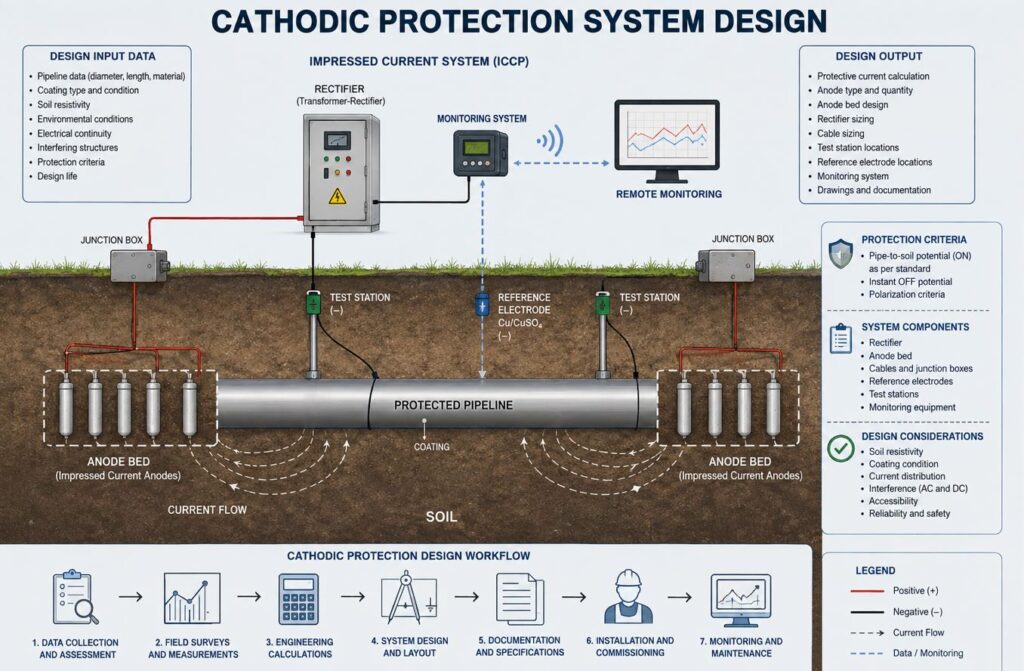
Impressed Current Cathodic Protection (ICCP) systems are commonly used for large structures or installations requiring significant protective current.
A typical ICCP system may include:
- transformer-rectifier units;
- impressed current anodes;
- surface or deep groundbeds;
- anode cables;
- junction boxes;
- test stations;
- permanent reference electrodes;
- monitoring equipment;
- electrical connections to the protected structure.
During the design phase, Italcorr determines the required system output, groundbed configuration, anode characteristics and monitoring arrangement.
Particular attention is given to achieving effective current distribution while limiting possible interference with neighbouring metallic structures.
Sacrificial Anode Cathodic Protection
Galvanic or sacrificial anode systems use electrochemically active metals to provide protective current without an external DC power source.
Depending on the environment and application, anodes may be manufactured from:
- magnesium;
- zinc;
- aluminium alloys.
The design includes calculation of:
- required protective current;
- individual anode output;
- total anode mass;
- number of anodes;
- anode spacing;
- expected anode consumption;
- system design life.
Sacrificial anode systems can be particularly suitable for smaller structures, isolated pipeline sections, tanks and installations where the required protection current is relatively low.
Groundbed Design
For impressed current systems, groundbed performance is critical to the overall efficiency of the cathodic protection installation.
Italcorr evaluates:
- soil resistivity;
- available installation area;
- required current output;
- anode type and dimensions;
- groundbed resistance;
- spacing between anodes;
- installation depth;
- expected service life;
- interference risks.
Depending on project requirements, the design may include shallow distributed groundbeds or deep anode groundbeds.
Reference Electrodes and Monitoring Points
An effective cathodic protection system requires reliable monitoring throughout its operating life.
The design may therefore include:
- permanent reference electrodes;
- potential measurement points;
- test posts;
- current measurement facilities;
- coupons;
- remote monitoring equipment;
- connections for synchronized ON/OFF measurements.
These facilities allow operators to verify system performance and identify changes in protection conditions over time.
Electrical Interference Assessment
Cathodic protection systems can interact with nearby metallic structures and electrical installations.
Potential sources of interference include:
- neighbouring cathodically protected pipelines;
- DC traction systems;
- railways;
- high-voltage power transmission systems;
- grounding installations;
- industrial electrical systems.
The design process considers possible DC stray current and AC interference and, where necessary, includes appropriate monitoring or mitigation measures.
Protection Criteria
Cathodic protection systems are designed and evaluated according to the applicable technical standards, project specifications and characteristics of the protected structure.
Depending on the application, assessment may include:
- pipe-to-soil potential measurements;
- ON potentials;
- instant OFF potentials;
- polarization criteria;
- current density;
- potential stability;
- interference measurements.
Correct interpretation of field measurements is essential because voltage drops in the soil and external electrical interference can affect measured potentials.
Design Documentation
Depending on the scope of the project, cathodic protection engineering documentation may include:
- design basis;
- technical calculations;
- protective current calculations;
- anode calculations;
- groundbed resistance calculations;
- equipment specifications;
- cable sizing;
- electrical diagrams;
- layout drawings;
- test station configuration;
- monitoring system requirements;
- bill of materials;
- installation requirements;
- commissioning procedures;
- inspection and maintenance recommendations.
The documentation provides the technical basis for construction, commissioning and future operation of the cathodic protection system.
Cathodic Protection for Different Structures
Italcorr develops cathodic protection solutions for a wide range of metallic assets, including:
Pipelines
Cathodic protection systems for gas pipelines, oil pipelines, water pipelines, firewater systems and industrial process pipelines.
Aboveground Storage Tanks
Cathodic protection of tank bottoms in contact with soil, sand foundations or other conductive environments.
Buried Tanks
Protection systems for underground storage tanks and associated metallic piping.
Industrial Facilities
Cathodic protection solutions for buried metallic networks, firewater systems, utility pipelines and other industrial infrastructure.
Metallic Foundations
Cathodic protection of steel piles, foundation structures and other metallic components exposed to soil or water.
Integration with Pipeline Integrity Surveys
For existing pipelines, cathodic protection design and optimization can be supported by specialized field surveys.
Italcorr integrates cathodic protection engineering with:
CIPS Survey (Close Interval Potential Survey)
For detailed evaluation of pipe-to-soil potentials and cathodic protection performance along the pipeline route.
DCVG Survey (Direct Current Voltage Gradient)
For locating and assessing coating defects.
PCM Survey (Pipeline Current Mapping)
For evaluating current distribution and identifying areas of increased current loss.
Pearson Survey
For detecting coating discontinuities along buried pipelines.
Stray Current Investigation
For identifying electrical interference and evaluating its influence on corrosion risk and cathodic protection performance.
The integration of design calculations with field diagnostic data allows cathodic protection systems to be optimized according to the actual condition of the structure.
Why Proper Cathodic Protection Design Matters
The effectiveness of cathodic protection depends strongly on correct engineering.
An inadequately designed system may result in insufficient protection, uneven current distribution, excessive energy consumption, interference with neighbouring structures or reduced equipment life.
A properly engineered cathodic protection system provides:
- effective corrosion control;
- optimized current distribution;
- improved asset reliability;
- reduced risk of corrosion-related failures;
- longer infrastructure service life;
- reduced maintenance and repair costs;
- reliable monitoring of protection performance.
Italcorr Cathodic Protection Engineering
Italcorr provides engineering support throughout the entire cathodic protection lifecycle, from preliminary assessment and system design to installation, commissioning, inspection and performance evaluation.
By combining cathodic protection engineering, corrosion diagnostics and non-destructive testing, Italcorr develops solutions focused on the long-term integrity and reliability of pipelines, tanks and other metallic infrastructure.
You may use our Cathodic Protection Calculator here