
Cathodic Protection of Pipelines
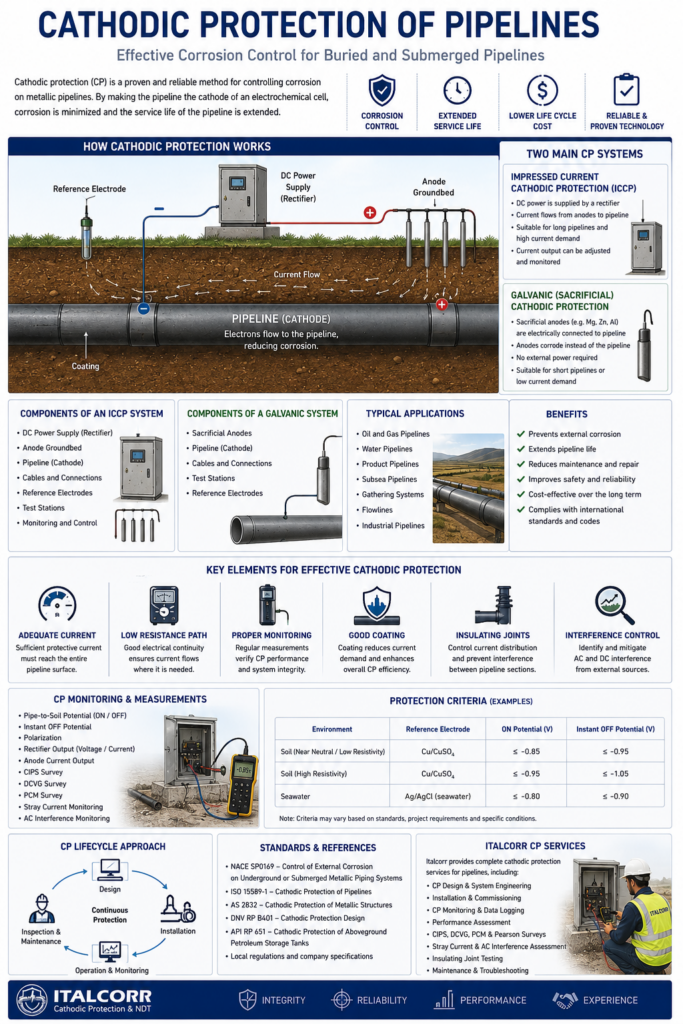
Cathodic protection is one of the most effective methods for controlling external corrosion of buried and submerged metallic pipelines. It is widely used in oil and gas pipelines, water transmission systems, industrial pipelines and other underground steel infrastructure.
Italcorr provides cathodic protection services for pipelines, including system design, installation, testing, commissioning, monitoring, inspection and performance assessment.
The objective of cathodic protection is to reduce the corrosion rate of the pipeline by making the protected structure act as the cathode of an electrochemical system.
Why Cathodic Protection Is Required
Buried steel pipelines are continuously exposed to soil and groundwater. Electrochemical reactions between the steel surface and the surrounding environment can cause external corrosion.
The corrosion process can be influenced by:
- soil resistivity;
- moisture and chemical composition of the soil;
- condition of the protective coating;
- coating defects and holidays;
- electrical continuity of the pipeline;
- stray DC currents;
- AC interference from nearby power lines;
- proximity to railways and other buried metallic structures.
Protective coatings provide the primary barrier against corrosion. However, coating defects can develop during installation or operation. Cathodic protection provides additional corrosion control at these exposed areas.
Cathodic Protection Systems for Pipelines
Two principal types of cathodic protection systems are used.
Impressed Current Cathodic Protection (ICCP)
An impressed current system uses an external DC power source, normally a transformer-rectifier, connected between the pipeline and an anode groundbed.
The system supplies controlled protective current to the pipeline.
Typical components include:
- transformer-rectifier units;
- anode groundbeds;
- reference electrodes;
- test stations;
- monitoring points;
- electrical cables and connections;
- insulating joints;
- remote monitoring equipment.
ICCP systems are particularly suitable for long pipelines and structures requiring relatively high protective current.
Galvanic Anode Cathodic Protection
Galvanic systems use sacrificial anodes made from electrochemically active materials such as magnesium, zinc or aluminium.
The anodes are electrically connected to the pipeline and gradually corrode while providing protective current to the steel structure.
Galvanic protection can be suitable for shorter pipeline sections, local protection and installations where relatively low protective current is required.
Pipeline-to-Soil Potential Measurements
Measurement of pipeline-to-soil potential is one of the fundamental methods used to evaluate cathodic protection performance.
Reference electrodes are positioned at the ground surface or installed permanently near the pipeline.
Measurements may include:
- ON potentials;
- Instant OFF potentials;
- depolarized potentials;
- rectifier voltage and current;
- anode current output;
- potential fluctuations;
- interference measurements.
The results are evaluated according to the applicable cathodic protection criteria and project requirements.
Diagnostic Surveys
For detailed assessment of pipeline cathodic protection and coating condition, Italcorr can integrate several diagnostic techniques.
CIPS Survey
Close Interval Potential Survey (CIPS) provides detailed measurements of pipeline-to-soil potential along the pipeline route.
The method helps identify sections where cathodic protection levels may be insufficient or excessive.
DCVG Survey
Direct Current Voltage Gradient (DCVG) is used to locate and evaluate coating defects on buried pipelines.
The survey measures voltage gradients in the soil generated by protective current flowing toward exposed steel at coating defects.
PCM Survey
Pipeline Current Mapping (PCM) is used to evaluate the distribution and attenuation of current along a pipeline.
It can help identify abnormal current losses, coating deterioration and electrical discontinuities.
Pearson Survey
The Pearson method can be used to locate coating defects by detecting changes in the electrical field around a buried pipeline.
Combining several survey methods provides a more complete understanding of pipeline coating condition and cathodic protection performance.
Stray Current and AC Interference
Pipelines located near electrified railways, industrial DC systems, high-voltage power lines or other infrastructure may be affected by electrical interference.
Stray currents can enter and leave the pipeline at different locations. Areas where current leaves the pipeline may experience accelerated corrosion.
Assessment may include:
- potential monitoring;
- current measurements;
- interference testing;
- data logging;
- identification of current discharge areas;
- evaluation of AC voltage;
- assessment of mitigation requirements.
Where necessary, appropriate mitigation measures can be designed and implemented.
Cathodic Protection Performance Assessment
The effectiveness of a cathodic protection system should be periodically verified throughout the operating life of the pipeline.
A comprehensive assessment may include:
- inspection of transformer-rectifier units;
- pipeline-to-soil potential measurements;
- Instant OFF measurements;
- verification of test stations;
- anode groundbed assessment;
- inspection of electrical connections;
- verification of insulating joints;
- CIPS, DCVG, PCM and Pearson surveys;
- stray current investigation;
- AC interference assessment;
- analysis of historical monitoring data.
The collected information allows engineers to determine whether the pipeline is adequately protected and identify areas requiring corrective action.
Maintenance and Optimization
Cathodic protection systems require regular inspection and maintenance to ensure reliable long-term operation.
Maintenance activities may include adjustment of rectifier output, replacement of damaged components, repair of cables and connections, replacement or rehabilitation of anode systems and improvement of monitoring installations.
Optimization of the system helps maintain adequate protection while avoiding excessive current consumption and unnecessary operating costs.
Applicable Standards
Cathodic protection of pipelines is designed, operated and evaluated according to applicable international and European standards, project specifications and regulatory requirements.
Depending on the pipeline and operating environment, relevant standards may include EN ISO 15589-1, EN 12954, ISO 18086 and other applicable technical requirements.
Italcorr Pipeline Cathodic Protection Services
Italcorr provides engineering and technical services covering the complete lifecycle of pipeline cathodic protection systems, including:
- cathodic protection system design;
- installation and commissioning;
- inspection and maintenance;
- pipeline potential monitoring;
- cathodic protection performance assessment;
- CIPS surveys;
- DCVG surveys;
- PCM surveys;
- Pearson surveys;
- stray current investigations;
- AC interference assessment;
- coating defect localization;
- troubleshooting and system optimization;
- technical reporting and recommendations.
The integration of cathodic protection monitoring with specialized pipeline survey techniques provides a comprehensive approach to corrosion control, pipeline integrity and long-term asset reliability.