Corrosion Engineering
Corrosion is one of the leading causes of deterioration in industrial infrastructure, with significant consequences for safety, operational reliability, and maintenance costs.
Corrosion Engineering is a specialized engineering discipline focused on understanding, assessing, preventing, and controlling corrosion through an integrated technical approach.
Italcorr provides specialized Corrosion Engineering services to support industrial operators, energy companies, utilities, and EPC contractors in managing corrosion risks and protecting critical assets.
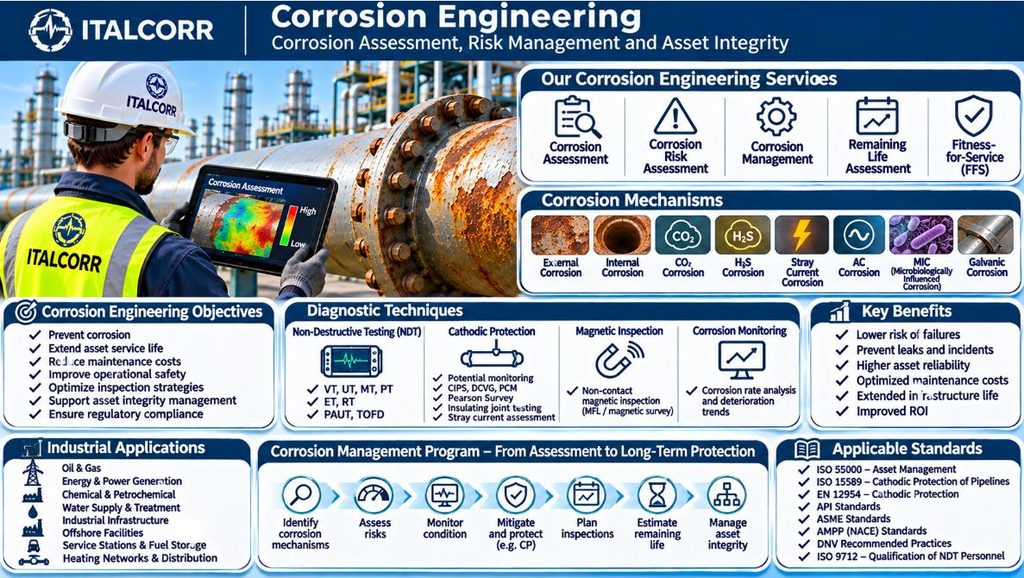
Objectives of Corrosion Engineering
Our activities are designed to:
- Prevent and mitigate corrosion
- Extend asset service life
- Reduce maintenance costs
- Improve operational safety
- Optimize inspection strategies
- Support infrastructure integrity management
- Ensure compliance with applicable technical standards and regulations
Corrosion Engineering Services
Corrosion Assessment
Assessment of corrosion conditions in industrial infrastructure through engineering analysis, inspection data evaluation, and field investigations.
Corrosion Risk Assessment
Identification, evaluation, and classification of corrosion risks based on operating conditions, environmental exposure, material properties, and potential degradation mechanisms.
Corrosion Management
Development of corrosion prevention, monitoring, and mitigation strategies to support long-term asset integrity and reliability.
Remaining Life Assessment
Estimation of the remaining service life of industrial assets based on corrosion data, measured wall thickness, deterioration rates, and relevant engineering criteria.
Fitness-for-Service Assessment (FFS)
Engineering assessment of the suitability of components and infrastructure for continued operation when corrosion, material loss, or other degradation mechanisms are present.
Fitness-for-Service evaluations may be performed using applicable engineering methodologies and recognized assessment standards.
Corrosion Mechanisms
Italcorr provides technical studies and assessments covering various corrosion mechanisms.
External Corrosion
Corrosion resulting from interactions between metallic structures and the surrounding environment, including soil, water, and atmospheric exposure.
Internal Corrosion
Corrosion caused by fluids transported, processed, or stored within industrial equipment and piping systems.
CO₂ Corrosion
Carbon dioxide-related corrosion, commonly encountered in Oil & Gas production and transportation systems.
H₂S Corrosion
Corrosion and associated material degradation mechanisms occurring in environments containing hydrogen sulfide.
Stray Current Corrosion
Corrosion associated with unintended electrical currents flowing through metallic structures and surrounding electrolytes.
AC Corrosion
Corrosion associated with alternating current interference, particularly where buried metallic pipelines are located near high-voltage power transmission lines.
Microbiologically Influenced Corrosion (MIC)
Corrosion processes influenced by the activity of microorganisms and their interaction with metallic surfaces and surrounding environments.
Galvanic Corrosion
Corrosion resulting from the electrical coupling of dissimilar metals or alloys in the presence of a common electrolyte.
Corrosion Inspection and Diagnostic Techniques
Italcorr integrates multiple inspection and diagnostic methods to evaluate corrosion conditions and industrial asset integrity.
Non-Destructive Testing (NDT)
- Visual Testing (VT)
- Ultrasonic Testing (UT)
- Magnetic Particle Testing (MT)
- Liquid Penetrant Testing (PT)
- Eddy Current Testing (ET)
- Radiographic Testing (RT)
- Phased Array Ultrasonic Testing (PAUT)
- Time of Flight Diffraction (TOFD)
These techniques support the identification of defects, wall thickness loss, material discontinuities, and other relevant degradation mechanisms.
Cathodic Protection Inspection and Testing
- Pipe-to-soil potential monitoring
- Close Interval Potential Survey (CIPS)
- Direct Current Voltage Gradient Survey (DCVG)
- Pipeline Current Mapping (PCM Survey)
- Pearson Survey
- Insulating Joint Testing
- Stray Current Interference Assessment
These methods support the evaluation of cathodic protection performance, coating condition, electrical interference, and corrosion protection effectiveness.
Non-Contact Magnetic Inspection
Non-contact magnetic inspection techniques can be used to identify magnetic anomalies potentially associated with material deterioration, corrosion-related defects, or stress concentrations.
The results support preliminary screening and prioritization of locations requiring detailed verification using conventional NDT methods.
Corrosion Monitoring
Monitoring of corrosion-related parameters, evaluation of corrosion rates, and analysis of deterioration trends to support maintenance planning and asset integrity management.
Industrial Applications
Italcorr Corrosion Engineering services are applicable to:
- Oil & Gas facilities
- Power generation and energy infrastructure
- Chemical processing plants
- Petrochemical facilities
- Water supply networks
- Industrial infrastructure
- Service stations and fuel storage facilities
- Offshore installations
- District heating networks
- Transportation and distribution infrastructure
Corrosion Management Programs
Italcorr develops tailored corrosion management programs that may include:
- Identification of corrosion mechanisms
- Corrosion risk assessment
- Periodic condition monitoring
- Corrosion prevention and mitigation strategies
- Cathodic protection assessment and optimization
- Inspection planning
- Remaining life assessment
- Asset Integrity Management
An integrated corrosion management approach helps identify potential deterioration mechanisms, establish inspection priorities, and develop appropriate maintenance strategies.
Benefits for Clients
The application of Corrosion Engineering methodologies can help:
- Reduce the risk of equipment failures
- Prevent leaks and corrosion-related incidents
- Improve operational safety
- Increase infrastructure reliability
- Optimize maintenance and inspection investments
- Reduce long-term maintenance costs
- Extend the service life of industrial assets
- Support regulatory and technical compliance
Applicable Standards and Regulations
Corrosion Engineering activities can be developed in accordance with applicable international standards, recommended practices, and project requirements, including:
- ISO 55000 – Asset Management
- ISO 15589 – Cathodic Protection of Pipeline Transportation Systems
- EN 12954 – Cathodic Protection of Buried or Immersed Metallic Structures
- API Standards – Inspection, integrity assessment, and equipment management
- ASME Standards – Engineering design, inspection, and Fitness-for-Service assessment
- AMPP (formerly NACE) Standards – Corrosion control and materials protection
- DNV Recommended Practices – Corrosion management and integrity assessment
- ISO 9712 – Qualification and certification of NDT personnel
The selection of applicable standards depends on the asset type, operating environment, inspection scope, and project-specific requirements.
Italcorr Corrosion Engineering Services
Italcorr provides comprehensive Corrosion Engineering services by integrating multidisciplinary expertise in cathodic protection, non-destructive testing, corrosion monitoring, and Asset Integrity Management.
Our engineering approach combines field measurements, inspection data, technical analysis, and corrosion risk evaluation to support effective asset protection strategies.
We assist industrial operators in identifying corrosion mechanisms, assessing infrastructure condition, developing mitigation measures, and optimizing inspection and maintenance programs.
Our objective is to support the long-term protection of industrial infrastructure, reduction of operational risks, and maximization of asset reliability and service life.